SPAS vs SARL in Algeria: Which Legal Structure Should You Choose for Your Startup?
July 28, 2026
Choosing the Right Legal Structure Is a Strategic Decision
Launching a startup is about more than simply developing an innovative product or service. One of the first strategic decisions every entrepreneur must make is choosing the legal structure that best suits their business.
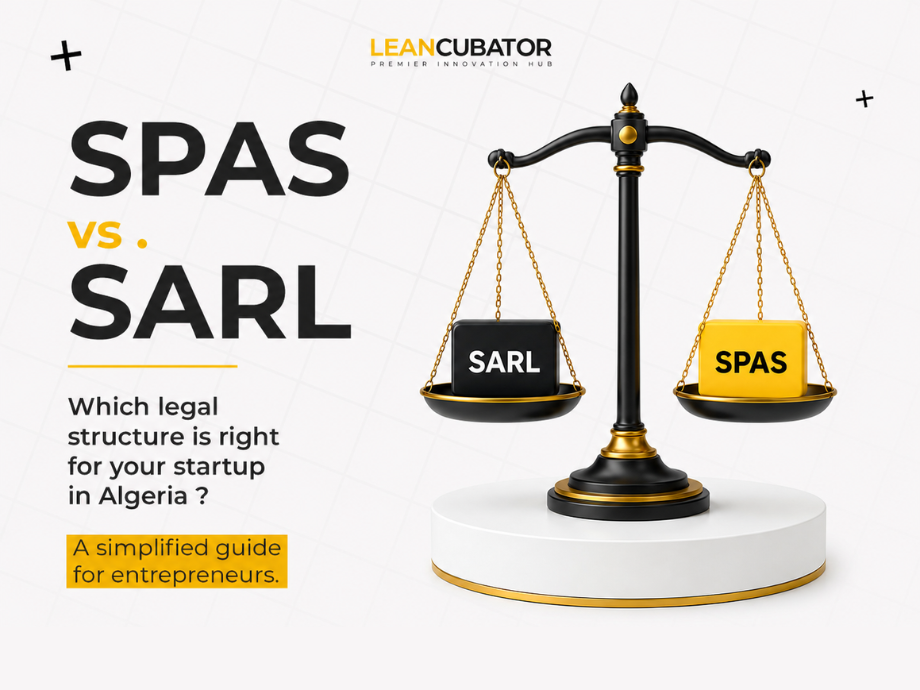
In Algeria, entrepreneurs generally choose between the SARL (Limited Liability Company) and the SPAS (Simplified Joint-Stock Company). While both legal structures provide limited liability, they were designed to meet different business needs.
Since the adoption of Law No. 22-09 of May 4, 2022, the SPAS has become the preferred legal framework for innovative startups seeking greater flexibility, investment opportunities, and strong growth potential.
This guide outlines the key differences between these two legal structures and helps you determine which one best fits your entrepreneurial project.
What Is a SARL?
The SARL (Limited Liability Company) is Algeria's traditional limited liability business structure. It remains one of the most commonly used legal forms for small and medium-sized enterprises (SMEs).
Its main characteristics include:
- Shareholders' liability is limited to the amount of their contributions.
- Share capital is divided into ownership interests (parts sociales).
- Maximum of 50 shareholders (partners).
- Traditional governance governed by the Commercial Code.
- Well suited for conventional SMEs and family-owned businesses.
For entrepreneurs who simply want to operate a business without seeking external investors, the SARL remains an effective and reliable option.
What Is a SPAS?
- The SPAS (Simplified Joint-Stock Company) was introduced under Law No. 22-09 of May 4, 2022, to support the development of Algeria's startup ecosystem.
- Unlike the SARL, the SPAS was specifically designed for innovative companies with high growth potential.
- Its main characteristics include:
- Reserved for companies holding the Startup Label.
- Can also be incorporated directly by projects holding the Innovative Project Label.
- Shareholders' liability is limited to their capital contributions.
- Share capital is divided into shares.
- No statutory minimum share capital.
- No maximum number of shareholders.
- Governance is largely determined by the company's Articles of Association.
Thanks to its modern structure, the SPAS is particularly well suited for startups planning to raise investment or scale rapidly.
SARL vs. SPAS: Key Differences
| Criteria | SARL | SPAS |
|---|---|---|
| Legal framework | Traditional company | Startup-focused company |
| Liability | Limited to capital contributions | Limited to capital contributions |
| Ownership | Ownership interests (parts sociales) | Shares |
| Number of owners | Maximum of 50 partners | One or more shareholders (no maximum) |
| Governance | Traditional | Highly flexible |
| Startup Label | Not required | Required (or Innovative Project Label upon incorporation) |
| Investor attractiveness | Moderate | High |
Can You Establish a SPAS Without the Startup Label?
Yes.
This is one of the least understood aspects of Algeria's Startup Law.
If your project has obtained the Innovative Project Label, you may establish your company directly as a SPAS, without first creating a SARL.
This allows founders to adopt an investment-ready legal structure from the outset while preparing to obtain the Startup Label after the company is officially incorporated.
One of the SPAS's Greatest Advantages: Industrial Shares
One of the SPAS's most innovative features is the ability to issue Industrial Shares (Actions d'industrie).
Unlike traditional shares, which are issued in exchange for financial contributions, industrial shares allow equity to be granted in exchange for:
- Technical expertise
- Know-how
- Work or professional services
- Strategic contributions
This mechanism enables startups to reward technical co-founders and key contributors who may not be able to invest financially but whose expertise is essential to the company's success.
For early-stage startups, this is a powerful tool for attracting and retaining top talent.
Why Convert a SARL into a SPAS?
- Many startups initially choose the SARL because they are unfamiliar with the SPAS or because this legal structure was not yet available when they incorporated.
- As their businesses grow, many founders decide to convert their SARL into a SPAS.
- The main reasons include:
- Easier fundraising
- Simpler onboarding of new investors
- More flexible governance
- Better equity structuring
- Increased attractiveness to venture capital and investment funds
- Ability to issue Industrial Shares
- If your startup plans to expand nationally or internationally, the SPAS generally provides a more suitable legal framework.
Which Legal Structure Should You Choose?
A SARL may be the right choice if:
- You operate a traditional business.
- You have a limited number of partners.
- You do not intend to raise external funding.
Your governance needs are relatively straightforward.
A SPAS is likely the better option if:
- Your company holds the Startup Label.
- Your project holds the Innovative Project Label.
- You plan to raise investment.
- You expect new shareholders to join over time.
- You want flexible governance.
- You are building a high-growth startup.
Conclusion
Choosing your legal structure is much more than an administrative formality. It directly impacts your company's ability to attract investors, structure ownership, recruit key talent, and scale efficiently over the long term.
For innovative startups, selecting the right legal framework from the beginning can save significant time, costs, and administrative complexity in the future.
Whether you are launching your first company or considering converting an existing SARL into a SPAS, understanding these differences will help you make an informed strategic decision.
Need Guidance?
At Leancubator, we support entrepreneurs throughout every stage of their startup journey—from choosing the right legal structure and obtaining the Innovative Project Label or the Startup Label, to fundraising, business development, and international expansion.
Contact our team today to find the legal structure that best supports your startup's ambitions.