Subscribe for Free!
Join our newsletter to explore innovative sustainability initiatives, eco-friendly tips, and impactful activities
Join our newsletter to explore innovative sustainability initiatives, eco-friendly tips, and impactful activities
5 Benefits of the Startup Label Every Founder Should Know in 2026
August 6, 2026
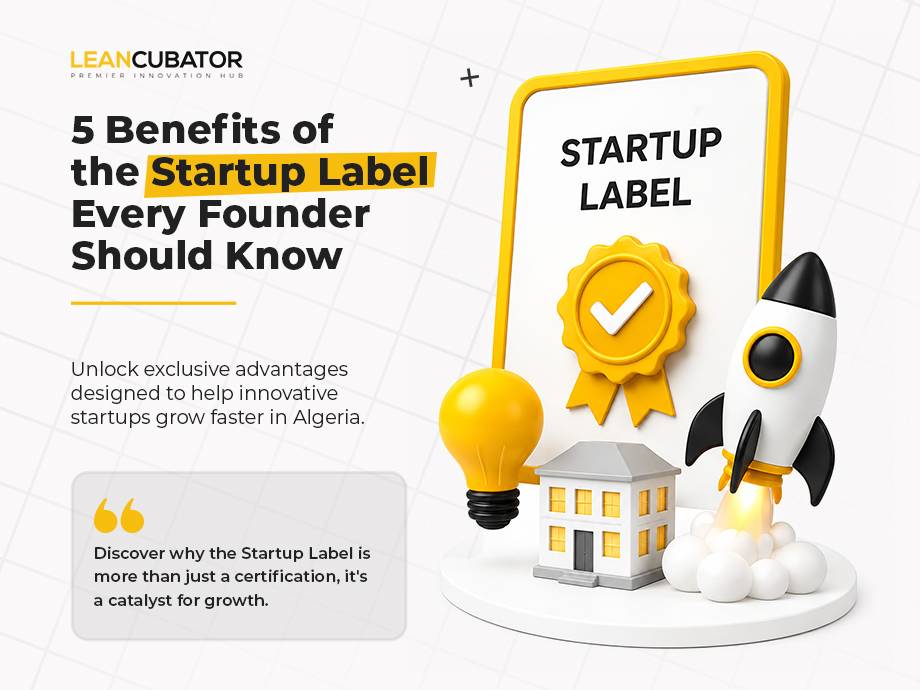
Algeria's Startup Label isn't just a badge of recognition, it's an institutional passport that unlocks tax breaks, financing, and legal advantages built specifically for innovative, high-growth companies. Since Executive Decree No. 20-254 (15 September 2020) created the National Labelling Committee for Start-ups, Innovative Projects, and Incubators, the framework has been refined repeatedly, most recently through Executive Decree No. 25-311 (1 December 2025), which updated the labelling criteria and added a new "Scale-up" label. Here are the five benefits every founder should understand before applying, plus a closer look at where to apply and what evaluators are really checking.
This is the label's headline advantage. Labelled startups benefit from a four-year exemption from corporate profit tax (IBS) or global income tax (IRG) for founders, plus exemption from the professional activity tax (TAP). These exemptions, first introduced under Law No. 19-14 and expanded by Law No. 20-07, were formalized in duration by the Finance Laws of 2021-2023. If your label is renewed, you can secure a fifth year of exemption, giving your company a meaningful runway to reinvest profits into growth rather than tax payments.
Labelled startups are exempt from VAT (TVA) on investment equipment, and benefit from reduced customs duties, down to 5%, on imported equipment needed for their activity. For hardware-dependent startups, or any company that needs to import specialized tools, servers, or lab equipment, this substantially lowers the upfront cost of getting operational.
The Algeria Startup Fund is a public venture capital vehicle created through a partnership between the Ministry of Startups and six public banks. It finances labelled startups through equity and quasi-equity investments, typically ranging from 10 to 100 million DZD per startup. Holding the label gives founders priority access to this funding, a critical advantage in a market where early-stage capital is scarce.
Law No. 22-09 (4 May 2022) introduced the SPAS (Société par Actions Simplifiée), a legal structure reserved exclusively for labelled startups. Often described as a hybrid between the SARL and the SPA, the SPAS offers no statutory minimum capital, no cap on shareholders, and the ability to issue industrial shares (actions d'industrie) to reward co-founders and key talent for expertise or work rather than cash. Without the label, this structure isn't available to you, making it one of the most concrete legal benefits of labelling.
This is a benefit that's still underused by founders, and it works both ways: it rewards labelled startups for partnering with large companies, and it rewards large companies for partnering with startups. Under Article 171 of Algeria's Tax Code and the Finance Law for 2023, large companies that contract R&D work to a company holding the "start-up" or "incubator" label, through a formal open innovation contract lasting at least six months, can deduct those expenses from their taxable profit, up to 200 million DZD.
For a labelled startup, this is a direct commercial incentive for corporates to work with you instead of building in-house or hiring a traditional service provider: your client gets a tax deduction specifically because they're contracting you. It's worth referencing in any B2B pitch to a large account.
More Detail: Eligibility Criteria for the Startup Label
Beyond the basic snapshot, here's what the National Labelling Committee actually checks
Baseline conditions: the company must be incorporated under Algerian law (SARL, EURL, SPA, or SPAS), registered for no more than 8 years at the CNRC, with annual revenue not exceeding 200 million DZD, a headcount under 250 employees, and at least 50% of the capital held by individuals (founders and/or business angels, as opposed to institutional or corporate shareholders).
Innovation and growth potential: the business model must be innovative in at least one dimension, whether that's the product, service, technology, process, or the business model itself, and the company must demonstrate genuine scalability.
Evaluation criteria used by the committee: applications are scored against five weighted criteria, namely a clearly documented customer problem with a measurable "before/after" solution, scalability supported by the cost structure (fixed versus variable costs and incremental margin), a founding team with clear complementarity across tech, business, and sector expertise, at least one piece of intellectual property filed with INAPI (a trademark, patent, or registered design), and evidence of traction, such as paying customers or signed letters of intent, backed by a financial forecast with traceable assumptions.
Common rejection reasons: applications are most often turned down because the innovation isn't clearly demonstrated, the model isn't shown to be scalable, the team section is too thin, or there's no evidence of real traction.
Process: applicants apply through startup.dz, and the committee reviews complete files within 30 days.
More Detail on www.startup.dz
A single-entry point for nearly everything described above. Run by the Ministry of Knowledge Economy, Startups and Micro Enterprises, it's where founders create an account, submit labelling applications for "Start-up," "Innovative Project," "Incubator," and now "Scale-up" status, and later manage renewals. Renewal applications require founders to submit updated performance data directly through the portal, including key achievements, revenue and customer growth, fundraising history, patents filed, and a short video presentation of the company.
The portal has scaled fast: over 7,800 companies have registered on the platform, with more than 2,300 having secured the "Start-up" label and its associated tax and financial benefits. Beyond applications, startup.dz also serves as the ecosystem's news and information hub, and links out to related programs such as the Algeria Startup Fund and the innovation.gov.dz open innovation platform.

Accredited by the National Committee for the Incubator Label in Algeria.