Subscribe for Free!
Join our newsletter to explore innovative sustainability initiatives, eco-friendly tips, and impactful activities
Join our newsletter to explore innovative sustainability initiatives, eco-friendly tips, and impactful activities
Incubators as Bridges: Algeria's Open Innovation Shift
April 25, 2026
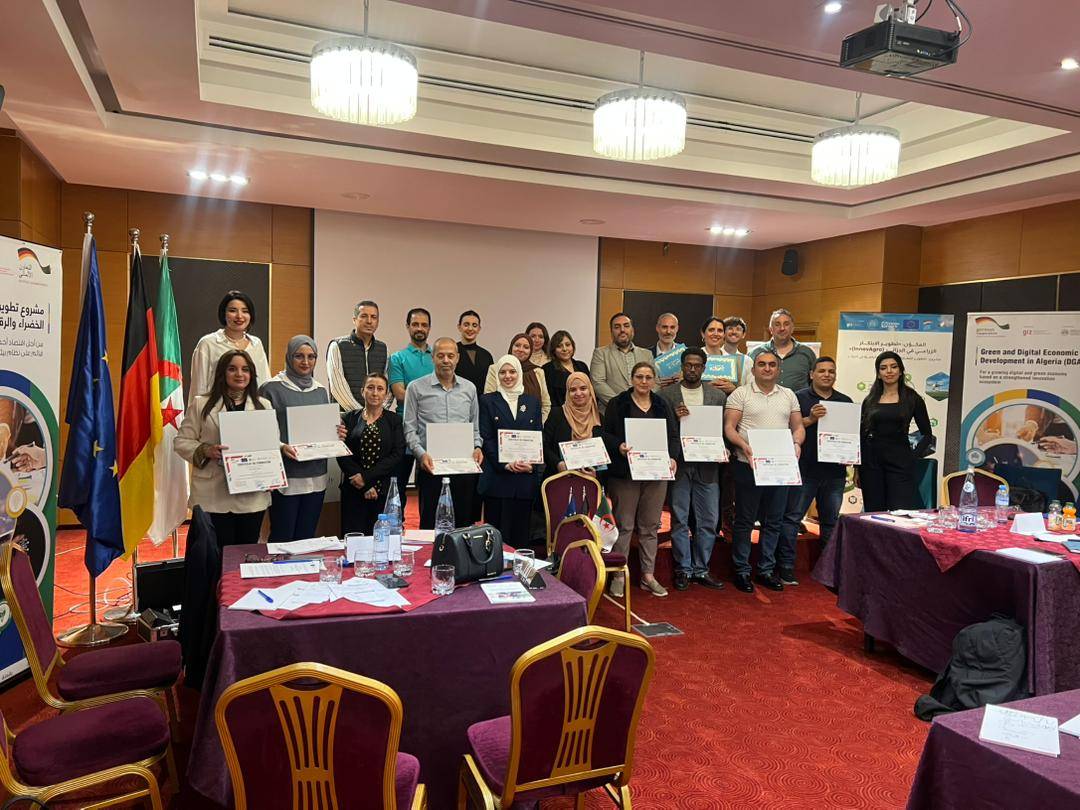
Open innovation in Algeria is no longer just a concept being discussed in conference rooms. Last week, it became something much more tangible.
From April 22 to 25, 2026, Leancubator was represented by Salem Hydaia, Project Coordinator, at the Op'Incub.dz training program a four-day intensive held at Hôtel Ferdi Lilly in Algiers, bringing together incubator managers from across Algeria's entrepreneurial ecosystem.
The program was organized under the Op'Innov initiative, part of the broader DGA/InnovAgro project co-financed by Germany and the European Union, implemented by GIZ in partnership with Ministry of Knowledge Economy, Startups and Micro-Enterprises (MECSME). The training was delivered by the consortium NLMTD – The Global Inspirator OÜ – Bonetti.
Algeria has a real opportunity in front of it. The 2023 Finance Law introduced a tax deduction mechanism that actively incentivizes companies to invest in open innovation partnerships with startups. The framework exists. The political will is there.
What has been missing is the operational expertise to make it work on the ground, the ability to structure collaborations, facilitate negotiations, and turn intent into actual pilot projects.
That is exactly what Op'Incub.dz was designed to address. Over four full days, around 20 incubator representatives worked through real scenarios drawn from the Algerian agri-food sector, equipped with practical tools they can apply immediately within their organizations. The methodology was clear from the start: Learning-by-Doing, not just Learning-by-Listening.
The first day set the foundation, understanding what open innovation truly means in the Algerian context, how to engage companies strategically, and how to navigate the legal and fiscal landscape, including the 30% tax deduction introduced by the Finance Law.
The second day focused on program architecture. Participants learned how to design a meaningful Challenge Statement that reflects a real company need, how to build trust between startups and established businesses, and how to map out an operational roadmap from startup scouting all the way to pilot implementation.
Day three tackled one of the most overlooked dimensions of open innovation: negotiation and contracts. Participants worked through intellectual property sharing, data sovereignty, and the complexity of three-way negotiations between companies, startups, and support organizations. A Maturity Audit framework was also introduced, a structured tool to assess startup readiness before proposing them as partners to companies.
The final day took a step back to look at sustainability. How do you move from a successful pilot to a commercial contract? How do you operate within the constraints of public sector companies? And how do you build systems that actually measure and sustain collaboration over time? These were the questions that shaped the last session.
Incubators are often seen as places where startups are born. But the role goes much further than that.
When well-equipped, an incubator becomes a trusted intermediary, the entity that translates a company's innovation challenge into a startup opportunity, that manages the matchmaking process with rigor, and that holds the space for collaboration to happen between actors who would otherwise struggle to work together.
For us at Leancubator, participating in Op'Incub.dz is part of a broader commitment, to strengthen not only the startups we support, but our own capacity to facilitate meaningful, structured, and lasting partnerships within the Algerian innovation ecosystem.
This training is the preparatory phase for the Open Innovation Competition and Bootcamp 2026, where participating incubators will play an active operational role, from translating company needs into challenge statements, to auditing startup maturity, to supporting the matchmaking process during the bootcamp itself.
The goal is concrete and measurable: 3 open innovation agreements in the AgriTech sector by the end of 2026.
We are proud to be part of this journey. And we look forward to sharing what comes next.

Accredited by the National Committee for the Incubator Label in Algeria.